Showing posts with label World War II. Show all posts

Wednesday, 25 June 2008

Music on the battlefields of World War II (Part three of three)

The Placetate

Sunday June 4th 1944: Members of the 12th US infantry regiment, stationed in England in preparation for the D-day invasion of Europe, are given the opportunity to record messages for their loved ones back home.

In total 83 men each make a three minute message. Unusually these recordings are pressed onto placetates – a forerunner of the flexi disc, made from thin sheets of clear plastic.

Placetates were unique for the times, in that they required no additional equipment to be played. After a recording had been pressed onto a disc, the spiral grooves were inlaid with a brylene thread coated with a mixture of flammable powder and a slow-burning fuel. Lighting the touch paper on the outside edge of the record, caused the fuse to burn at a steady rate, releasing the ‘trapped’ sound as the flame worked its way towards the centre. Placetates were surprisingly audible at close range but could be amplified by laying the disc on a specially designed speaker plate.

Colonel Hayden Merett worked in communications and espionage from 1942 until 1956 and supervised the development of placetates for military use:

“We began experimenting with placetates in late 1942 and started using them in the field about a year later. Initially we found them very useful for conveying sensitive data, since any message they carried would self-destruct as it was played. Towards the end of the war, our forces were using them to set up ambushes. Say you had some placetates containing recordings of people talking. You could light two or three in a selected location to draw the enemy towards the sound of the voices, while you moved in and attacked from behind.

“It always struck me as ironic that roughly the same amount of gunpowder went into a standard .30 M1 round as did into a regular sized placetate. Every one of these things we made was one less bullet on the battlefield, but they ended up saving a lot of lives, especially after we began using them as decoys.”

After the war, the US military ended its experiments with placetates. The technology lay dormant for twenty years before being rediscovered and improved upon by a pair of San Francisco teens - Joey and Daniel Mileman

Daniel Mileman:

“Our old man was in the army and had served in Europe. One day we were cleaning out the garage and we found the old placetate press which he had used to make recordings during the war. Joey was studying chemistry at USFCA. He soon figured out a way to make a placetate that released coloured smoke as it played. Later we worked out how to lay down certain mind-expanding substances in the grooves. The first thing we tried was a cannabis resin, but we used way too much. We were tripping hard for hours! After we had refined the process we shared our discovery with close friends. We got to be quite a hit at parties. The next logical step was to go into business.

“We were soley responsible for the placetate pressings of Jimmy Hendrix and Jefferson Airplane songs that you could pick-up in San Francisco, circa 1967/8. Eventually the demand got so high that we began selling them by mail order. We were even getting commissions from bands and record companies! The great thing was that because placetates are one-use items, we always had a steady stream of return customers. We ended up getting quite rich off the back of it, which at the time was against our anti-materialistic ethos, although not any more, ha, ha!”

The Mileman brothers’ profitable enterprise ended abruptly in 1971, when a light aircraft crash-landed off Ocean Beach, killing Joey Mileman and his girlfriend, who were surfing nearby. Placetates remained a novelty item and were often sold as indoor fireworks until a series of accidental blazes led to them being banned from public sale.

In 2006, a fire broke out at The John F. Kennedy Archive of Military Records, in Illinois, where copies of the placetates made by the men of 12th Infantry regiment were housed.

Scott Gudge was one of the firemen who attended the scene:

“The placetates were going off in the heat, but none of the attending fire crews knew anything about them. Over the sound of the flames I could hear men talking, so I naturally assumed that there were people trapped somewhere nearby. We took down the door to the room where the voices were coming from but no one was there. It turns out that we were chasing ghosts.”

Friday, 6 June 2008

Music on the battlefields of World War II (Part two of three)


NYLON GUITAR


Artie pulls a shapeless piece of thick cloth, the colour of unbleached cotton, out of an open suitcase. At first glance, it looks like it might be a straightjacket. There is a large round hole, roughly in the centre of it. A row of wooden pegs poke through the end of a long, reinforced tab. The tight stitching along the seams has pulled the fabric into ridges, giving it the appearance of a garment turned inside out.

He throws it onto the floor of the dressing room, shuffling around on his knees, spreading it out and smoothing it over with his hands as, behind him, the lid of the case slowly falls closed. We all stare down at the mangled form of a guitar, squashed almost flat on the bare concrete. The material is bruised with oil stains and brown tide marks.

“That looks pretty creased Artie,” says Bill. “Want me to iron it for you?”

“Nah.”

He pulls on the fret board so that it looks slightly less crooked than before, then gets himself upright and rubs his back.

“Ok, starch it and string it.”

Mike unzips a bulging canvas holdall, stuffed full of aerosols.

“You might want to cover your mouth,” he says.

He removes two of the canisters from the bag. Taking one in each hand he begins to spray them erratically a couple of feet above the cloth. Everybody retreats to the walls, as a petroleum-smelling vapour fills the room.

“Always comes home smelling of that stuff,” says Ruth looking disapprovingly in Artie’s direction, from her chair in the far corner

“It hides the smell of pussy”

“Like at your age anyone’s going to be throwing some of that your way.”

The cloud begins to drift towards the outer reaches of the room, engulfing the food on a nearby buffet table.

“Didn’t think we’d be eating those sandwiches anyhow,” says Bill

“Won’t be now,” replies Mike.

On the floor in front of us, the body of the guitar is rising like a loaf of bread, taking on a three-dimensional shape.

Artie nudges me in the side with a bony elbow.

“You seen that before?”

“I saw that footage James Ashling shot of you in the 60s.”

He nods. In front of us the hissing of the aerosols stops. Mike reaches down and flips the guitar onto its back. The material is mottled with wet and dry patches. He shakes the cans and then carries on spraying, up and down the instrument.

“The fretboard is hollow,” says Bill “I made it with pockets sewn inside. They trap the air and help with the sustain. The drawback is that the sound becomes a little unpredictable. Not one for the perfectionists.”

“It’s a quality instrument that favours the more intuitive musician…” says Artie, adopting the cultured tones of classical music buff.

“…Unlike those cheap-ass ones he sells on his website.”

“I prefer to think of them as authentic,” says Bill. “They’re based on the same design as the ones the U.S. airmen used to make with their parachutes*.”

The aerosols begin petering out, until they are weakly spraying air. Mike places them on the table next to the platter of tainted sandwiches. The guitar lies face down on the floor, its sides bulging outward, as if it has been overfilled with air. He stands it upright, fishes a notched cardboard spool of guitar strings from his pocket and begins attaching the wires, one by one to the bridge, running them along the fret board and forcefully tying them off around the wooden pegs.

“The tuning isn’t so important,” remarks Bill. “Once you apply the spray the guitar enters a dynamic state. You play it more on what feels right.”

As Mike fixes the last string, Artie wanders over and inspects his work.

“Tell them just one spot, behind me, centre stage,” he says. “Nothing too low. And no footlights.”

“Will do,” says Mike as he leaves the room.

Artie picks up the guitar by the neck and offers it to me.

“You wanna get a feel for it?”

It weighs much less than I expect, like something made out of plywood. In spite of being drenched by the aerosols, the material is already remarkably dry. I turn it over, as if I am about to play it left handed. The bodywork leaves greasy smudges on my shirt.

“Don’t play it or nothing. It’ll throw my act off time,” says Artie.

On the concrete floor, a dense oily stain surrounds the stencilled, slightly wonky double image of a guitar.

“Practically every place we’ve played has something like that,” says Bill. “I like to think of it as leaving an authentic piece of blues memorabilia on the premises.”

Artie takes the instrument from me. He leans against the buffet table, one corner wedged between his buttocks and plays a couple of bars. It’s a hard pitted sound, more like a drum than a guitar; a sound with all the melody slapped out of it.

“When it’s tight like that, it eats up the harmonics. A quarter of an hour and it’ll begin to warm up.”

The door to the room opens a crack and the promoter puts his head around the side.

“We’re ready when you are John,” says Bill.

“Give it five minutes. We’re just getting the last of the equipment off stage.”

* * * * *

Artie’s live set is tailor-made to suit the changing state of his guitar. The punchy, primitive blues of the first three songs gradually shifting towards something more melodic as the fibres in the material loosen up.

It’s a performance that stands as a metaphor for a life of scrapes and hard knocks - a musical journey from the brash, vigour of youth to the feebleness of old age. During the last five minutes of the set, the guitar is withering in Artie’s hands. It’s deeply moving, watching him battle to get music out of an instrument that will no longer play the tune he wants, or any tune at all. After a chain of bum notes it finally gives out on him, leaving him to bark and growl the remainder of the song a cappella, the wilted instrument hurled down onto the stage at his feet.


*HISTORICAL BACKGROUND

Circa 1941, it was common knowledge among American airmen that an engine lubricant, in general use by the U.S. military, acted as a powerful starch on parachute material. It wasn’t long before enterprising troops harnessed this discovery for their purposes, employing any needlework skills they had in stitching surplus fabric into items of furniture. Typically they crafted tables and small stools, which could be made rigid with the application of engine lubricant and then collapsed and easily transported when not in use. Other soliders, more interested in self preservation, used the same materials to create primitive bullet proof vests. While these were of low quality, they undoubtedly saved some lives.

The first nylon musical instruments appeared around 1942, with guitars being most popular, although violins and even cellos and double basses were also developed. An uncredited sewing pattern for what became the standard guitar model appeared in the November 1943 edition of American Patriot magazine, which was freely circulated among U.S. Servicemen.

Nylon guitars, in their early incarnation, could be played for up to ten minutes before the taut bonds, that gave the fabric its rigidity, weakened and the material reverted to its original state. Short sets of well-known songs were soon replaced by bespoke compositions that often took the form of extended monologues with musical accompaniment – a style that is still occasionally referred to as 'G.I. Blues'. Staples such as Bearcat Blues and Monday Morning Dewdropper were all written on the battlefield; their hazy origins and multiple authors eventually leading them to be credited to ‘The Unknown Solider’, following numerous court cases.

The instrument also provided a leg-up for groups such as The Torpedoes and solo artists like Nils Parker, who honed their skills while on active duty and then went on to enjoy fruitful careers in the entertainment industry after the war. The most successful of these groups - The Big Six - toured for almost four decades across America and Europe, before taking up residency at Laredo’s Casino in Las Vegas. Here they continued to play sell-out shows five days a week until 1997 when the last original member of the group - Colonel John Wilson - passed away.

Dismissed as a novelty instrument for much of the 1980s and 90s the nylon guitar has enjoyed a reversal of fortunes at the beginning of the 21st century with many new groups championing the instrument. This in turn has lead to new designs becoming commercially available. Somewhat controversially the patent on the instrument is held by the American armed forces. Although it has been disclosed that profits from the sale of the guitars go to a fund dedicated to providing care and support for American soldiers injured in the line of duty, there remains an active online trade in versions of the instrument that do not line the pockets of the U.S. Military.

Thursday, 29 May 2008

Music on the battlefields of World War II (part one of three)


The Singing Shilling

In his autobiography, Treading the Loose Boards, the actor and playwright, Malcolm Bevins, writes of his time as a soldier in the British army, during World War II. He recalls, one morning, waking up to find the skies above Normandy filled with silver discs, descending on nylon parachutes and provoking sporadic fire from German air defences - a spectacle that he compares to the unexpected arrival of a fleet of flying saucers.

Bevins had witnessed an airdrop of clockwork-operated seven inch singles – what had become known among the troops as ‘Singing Shillings’, because of their resemblance to silver coins as they tumbled out of the sky. They were one part of multi-faceted initiative by the War Office to keep morale high on the battlefield.

The Singing Shilling was a basic, if ingeniously designed record player constructed around a 7 inch vinyl single. It was housed inside a sealed, circular tin, similar to a film reel canister, roughly 8 inches in diameter and about an inch thick. Around the circumference there was a speaker grill and a small hole for the turning key.

If you prised the canister open, inside you would find a clockwork mechanism, a small speaker, and a vinyl disc with a roving stylus on either side, that was designed to drop down onto whichever surface was upright.

Winding the mechanism had the joint effect of providing enough power for a single play of the disc while also returning the stylus to the beginning of the record. On early models this would entail dragging the needle in reverse through the spiral groove, effectively playing the contents backwards at the same speed as the key was being turned. Later the design was improved, allowing the stylus to be lifted off the platter while winding was in progress and only released once the key had been removed.

The recordings for Singing Shillings were made at a small studio owned and operated by the War Office. They were subsequently pressed and assembled at a factory in what was then the village of Easthampstead. A discography, now viewable though the public records office, lists over 800 titles, typically songs and comedy sketches, intended for allied troops. A small number were recorded in German and used as propaganda. For reasons that remain a mystery, a further 53 titles are currently undisclosed and their details not scheduled to be released into the pubic domain until the year 2015.

My first encounter with Singing Shillings was on my 24th birthday when I was given one as a present. It is a recording of a young lady by the name of Marjorie Cottingham, who in the torn black and white photograph, pasted onto one side of the tin, looks every inch the chaste vicar’s daughter. The A-side is her performance of a song titled: Three Little Birds. The B-side is her spoken rendition of The Lord’s Prayer. The sound is weak – you need to be sitting no more than a few feet from the player to hear the music – and the sentiment decidedly trite, and yet I continue to be fascinated by it. In the intervening years I have expanded my collection to 17 Singing Shillings and would have more if their relative scarcity and growing desirability hadn’t priced me out of the market.

I feel obliged to add one note of warning to any would-be collectors. German forces would often intercept airdrops of Singing Shillings and booby trap them. Some of these booby-trapped devices are most likely still in circulation and so a degree of caution is necessary. There is a video on youtube which clearly demonstrates how to check Singing Shillings for explosives and disarm them if necessary. I have performed the operation a couple of times in my back garden. It is a simple procedure requiring nothing more than a flat-headed screwdriver and a pair of pliers.

Monday, 26 May 2008

True Originals (Part 1: Radioheath)

In the first of an occasional series we celebrate the inspirations behind today’s critically acclaimed acts and multi-platinum sellers.

Radioheath (1945-1957)

Modern Day Counterpart: Radiohead


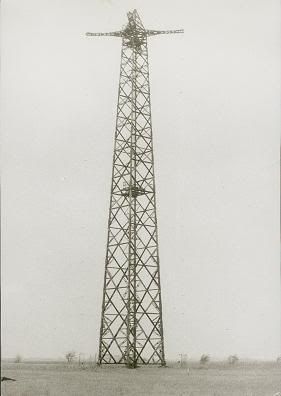
This ten-piece swing band took their name from a desolate acreage of Dartmoor, briefly colonised by radio towers during World War II after it was discovered that the underlying geology added a natural encryption to outgoing signals. The transmissions could be decoded in the field using quarried samples of the bedrock. It was this chance discovery gave birth to the mineral encryption devices still in common usage by British forces in today's war zones.

Band leader Sam Redlark’s enthusiastic consumption of amphetamines during his time as a soldier had done permanent damage to his nervous system, leaving him in a perpetually agitated state and unable to play the sedate waltzes which had earned him a living in the pre-war era. Upon his return to civilian life he began to compose music based on what were described by one commentator at the BBC as “disconcerting time signatures and shifting-sand melodies”.

Radioheath soon found themselves shunned by the ballroom dance circuit and experienced decades of obscurity before their slender body of work gained favour with a fresh generation of experimental jazz artists in the 1990s.